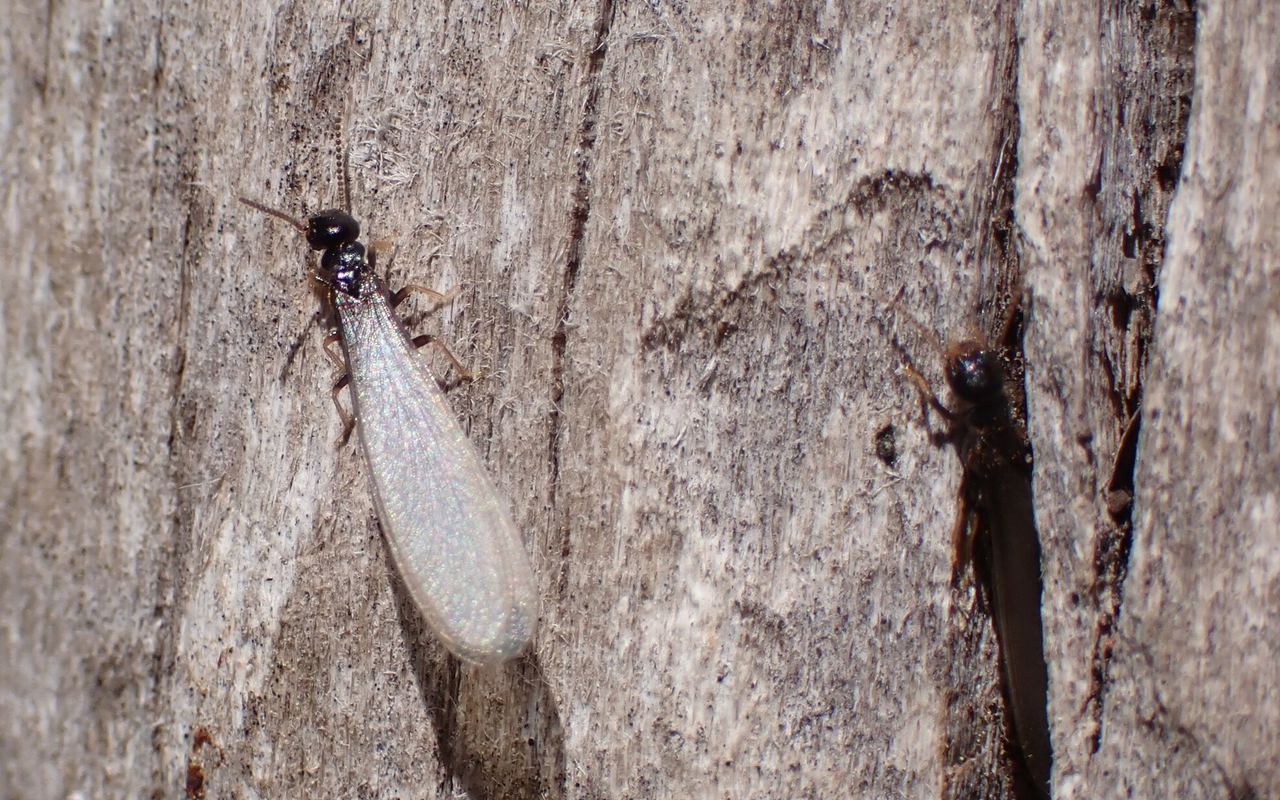
When they swarm here
The Formosan subterranean termite swarms on the Gulf Coast on warm, humid evenings in late spring, most heavily in May and June, right around dusk. Hundreds or thousands of winged reproductives, called alates, pour out of a mature colony at once and fly toward lights, which is why a Houston-area homeowner’s first real sign of a Formosan colony is often a cloud of them at the porch light or against a lit window on a muggy evening.
Native eastern subterranean termites swarm earlier, in the daytime, usually on warm days after rain in late winter and early spring. Drywood termites, less common here, swarm at other times. The timing and the behavior, evening versus day, help identify which termite you have, which matters for the treatment.
Termite swarmer or flying ant?
That last sign is the one people actually find, because the swarmers themselves die fast. A little pile of clear, equal-length wings by a window or a light means a swarm happened inside or right against your home, and that means a colony is on or very near the structure.
- Waist: a termite is straight-sided, like a grain of rice; a flying ant has a pinched, wasp-like waist
- Antennae: a termite’s are straight and beaded; an ant’s are elbowed
- Wings: a termite has four wings of equal length, all longer than its body, and they drop off easily; an ant has two larger front wings and two smaller back wings
- The pile: a scatter of identical dropped wings on a windowsill, in a spider web, or on the floor is a termite swarm
What a swarm actually means
A swarm is not the start of the problem, it is the sign the problem is mature. A colony only produces winged reproductives once it is well established, which on the Gulf Coast usually means it has been feeding for a few years. The swarm is the colony trying to spread to new sites. The individual swarmers almost all die, so the swarm stopping means nothing, the colony that produced it is still in the soil and still feeding.
For a slab home this is the moment to act. The swarmers came from a colony that reached your wood through the soil and the slab, and every month it keeps feeding is more damage to structural framing. Calling when you see the swarm costs a treatment; waiting until the damage shows costs a contractor.
What to do if you see a swarm
Collect a few of the swarmers or the shed wings in a bag or a jar, so the species can be confirmed. Note where they came out, a window, a weep hole, a crack in the slab, a spot on the wall, because that points to where the colony reached the structure. Do not spray them; killing the visible swarmers does nothing to the colony and can interfere with the inspection.
Then call an experienced local exterminator for a termite inspection. The inspection follows the swarm point to the entry route, checks the slab perimeter, the plumbing penetrations, and the moisture, and determines whether it is Formosan or native, which shapes the treatment. Texas A&M AgriLife Extension keeps free, regionally specific guidance on identifying and managing Gulf Coast termites.
Further reading: Texas A&M AgriLife termite resources.
If you would rather hand this to somebody, see Termite Treatment in Missouri City, TX or call 281-801-0043.